
THCV Products
THCV products contain tetrahydrocannabivarin, a minor cannabinoid with a shorter propyl side chain than delta-9 THC, known for clear-headed, energizing effects. Elevate's THCV lineup is hemp-derived and third-party lab tested.

THCV products contain tetrahydrocannabivarin, a minor cannabinoid with a shorter propyl side chain than delta-9 THC, known for clear-headed, energizing effects. Elevate's THCV lineup is hemp-derived and third-party lab tested.

Adult use only 21+
Filters

Compare Products
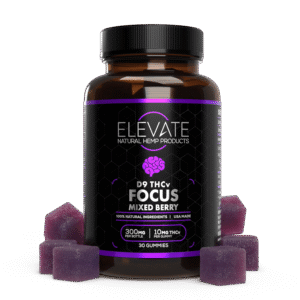
A focused lineup of THCV-driven edibles formulated for clear-headed, energetic daytime sessions.
| Product | Potency | Type | Best For |
|---|---|---|---|
THCv Gummies | THCV hemp blend | Hybrid THCV Gummy | Daytime focus & active routines |
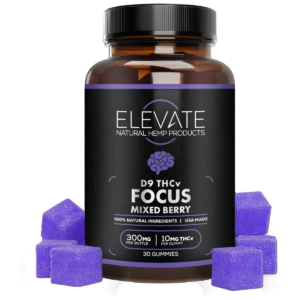
Focus Gummies | Focus-formula hemp blend | Functional Focus Gummy | Work sessions & sharp concentration |
THCV vs. THC, CBD, and Other Cannabinoids
Not all cannabinoids interact with your body the same way, and THCV is perhaps the most striking example of how subtle molecular differences produce dramatically different outcomes. To make informed decisions about THCV products, you need to understand exactly where this compound sits relative to the cannabinoids you already know —THC, CBD, CBG, and CBN.
The most important distinction begins at the CB1 receptor, the primary endocannabinoid receptor in the brain and central nervous system. THC is a well-known agonist of the CB1 receptor — it binds to and activates it, producing the classic psychoactive high along with appetite stimulation. THCV, however, behaves in an almost paradoxical fashion. At low doses, preliminary research suggests THCV acts as a CB1 receptor antagonist, meaning it may actually block activation rather than trigger it. This is why THCV effects are so often described as clear-headed and energizing rather than sedating — and why users report appetite modulation rather than the intense hunger commonly associated with THC.
At higher doses, the picture shifts. THCV may begin to partially activate the CB1 receptor, producing mild psychoactive effects, though users generally describe these as shorter-lived and more focused than those from THC. THCV also interacts with the CB2 receptor, which is distributed primarily throughout the immune system and peripheral tissues. Early-stage research has studied THCV's CB2 activity for its potential role in supporting metabolic and cellular wellness, though much of this work remains preclinical.
CBD, by contrast, has little direct binding affinity for either the CB1 or CB2 receptor. Instead, it works through indirect mechanisms — modulating receptor signaling, interacting with serotonin pathways, and influencing the way the body processes its own endocannabinoids. This makes CBD and THCV complementary rather than redundant, which is one reason many full spectrum formulations include both.
Other minor cannabinoids round out the comparison. CBG, sometimes called the "parent cannabinoid" because other cannabinoids are synthesized from its acid form, has been studied for its potential to support focus and digestive comfort. CBN, which forms as THC ages and oxidizes, is most commonly associated with relaxation and sleep support — essentially the opposite end of the experiential spectrum from THCV's reported energizing profile.
Here is a simplified comparison:
- THC: Strong CB1 agonist; psychoactive; appetite-stimulating
- THCV: CB1 antagonist at low doses, partial agonist at higher doses; may support energy and appetite modulation
- CBD: Minimal direct receptor binding; is associated with calm and balance
- CBG: Partial CB1 and CB2 interaction; has been studied for focus and gut comfort
- CBN: Mild CB1 affinity; users report sedation and sleep support
Understanding these distinctions matters because it shapes which products — and which cannabinoid combinations — align with your specific wellness goals. A full spectrum THCV product leverages multiple cannabinoids working in concert through what researchers call the entourage effect, while an isolate-based product delivers THCV's unique receptor profile without interference from other compounds. Neither approach is inherently superior; the right choice depends entirely on the experience you are looking for.
Potential Benefits of THCV: What the Research Suggests
The conversation around THCV benefits has grown rapidly in recent years, fueled by a wave of early scientific studies and mounting anecdotal reports from users. But separating genuine findings from marketing hype requires a careful look at what the research actually says — and, just as importantly, what it doesn't yet confirm.
Appetite Modulation: The "Diet Weed" Reputation
Perhaps the most widely discussed property of THCV is its potential role as an appetite suppressant. Unlike THC, which is well known for stimulating hunger by activating the CB1 receptor, THCV at lower doses appears to act as a CB1 antagonist — meaning it may block the very receptor responsible for those familiar munchie cravings. Animal studies have shown that THCV administration is associated with decreased food intake and reduced body weight gain over time, which has led researchers to investigate its relevance for human metabolic health.
This unique mechanism has naturally sparked interest in THCV's connection to weight loss. While no large-scale human clinical trials have definitively established THCV as a weight management tool, preliminary research suggests that its appetite-modulating properties could complement lifestyle changes for individuals looking to manage caloric intake. Users report feeling less driven by food cravings when incorporating THCV into their daily routines, though individual experiences vary widely and should not be mistaken for clinical evidence.
Energy, Focus, and Mood
Another area generating significant interest is the potential energy boost many users describe after consuming THCV. Rather than the sedative, couch-locked feeling sometimes associated with high-THC cannabis strains, THCV has been studied for its stimulating, clear-headed qualities. Users frequently describe feeling more alert, motivated, and mentally sharp — which is why some wellness brands position THCV products as daytime cannabinoids designed for productivity rather than relaxation.
The science behind this reported energizing effect likely ties back to THCV's receptor profile. At low to moderate doses, its CB1-blocking activity may counteract the drowsiness pathways that other cannabinoids activate, while its partial agonist activity at higher doses appears to produce a short-lived, focused psychoactive experience that differs markedly from a standard THC high. Researchers are still mapping the precise neurochemical pathways involved, but the pattern across both preclinical data and user reports is consistent enough to warrant continued investigation.
Blood Sugar Regulation and Metabolic Health
Beyond appetite and energy, some of the most promising early research on THCV effects involves glycemic control. A small but notable human study found that THCV may support improved fasting glucose levels and enhanced pancreatic beta-cell function in individuals with type 2 diabetes. These findings are preliminary and require replication in larger, more diverse populations, but they point toward a metabolic profile for THCV that is genuinely distinct from any other cannabinoid studied to date.
Bone Health and Neuroprotection
Emerging preclinical research has also explored THCV's potential relevance to bone cell stimulation and neuroprotective pathways. Some animal models suggest that THCV may support bone growth signaling, which has implications for conditions involving bone density loss — though this work remains in very early stages. Similarly, THCV's interaction with CB2 receptors has been studied for possible neuroprotective properties, particularly in models related to motor function and neurodegeneration.
A Realistic Perspective
It is important to emphasize that the body of research on THCV, while exciting, is still relatively small. Most studies involve animal models or very limited human sample sizes. No regulatory body has approved THCV for any specific health condition, and consumers should approach bold marketing claims with healthy skepticism. The most responsible way to think about THCV benefits right now is as a promising area of cannabinoid science that merits attention — not as a proven solution for any particular health goal.
What the research does make clear is that THCV occupies a genuinely unique pharmacological space. Its dual behavior at CB1 receptors, its metabolic associations, and its reported stimulating qualities collectively suggest a cannabinoid worth watching closely as clinical research matures and more rigorous human data becomes available.

WHAT IS THCv?





FAQ
What is THCV and how is it different from THC?
THCV (tetrahydrocannabivarin) is a naturally occurring cannabinoid found in Cannabis sativa. While structurally similar to THC, THCV has a propyl (three-carbon) side chain instead of THC's pentyl (five-carbon) chain. This molecular difference fundamentally changes how THCV interacts with the endocannabinoid system. At low doses, THCV may act as a CB1 receptor antagonist — blocking activation rather than triggering it — which is the opposite of how THC behaves.
What are the effects of THCV products?
THCV effects are commonly described as clear-headed and energizing rather than sedating. At low doses, early research suggests THCV may modulate appetite rather than stimulate it, and it may block CB1 receptor activity. At higher doses, THCV may produce mild psychoactive effects that users report as short-lived compared to delta 9 THC.
How does THCV interact with the endocannabinoid system?
THCV has a unique dual-receptor profile. At the CB1 receptor in the brain, THCV behaves as a neutral antagonist at lower doses, potentially blocking receptor activity. At higher doses, it may shift toward partial agonism. At the CB2 receptor, found in immune tissues and peripheral organs, THCV has been studied for its partial agonist activity. This dose-dependent variability is rare among cannabinoids.
Why are most THCV products hemp derived?
THCV is classified as a minor cannabinoid because it occurs in much lower concentrations than THC or CBD in most cannabis cultivars. Even African sativa landrace strains that express higher THCV levels rarely produce concentrations rivaling dominant cannabinoids. This scarcity is why most commercial THCV products rely on advanced extraction and isolation techniques from hemp to concentrate the compound into usable formats.
How does THCV compare to CBD and other cannabinoids?
Unlike CBD, which does not directly activate the CB1 receptor and is non-psychoactive, THCV has a dose-dependent relationship with CB1 — acting as an antagonist at low doses and a partial agonist at higher doses. Compared to THC, which fully activates CB1 and stimulates appetite, THCV may modulate appetite and produce clear-headed, short-lived effects. Each cannabinoid — THCV, THC, CBD, CBG, and CBN — interacts with the endocannabinoid system in meaningfully different ways.