Full Spectrum CBD Oil: What It Is & Why It Matters
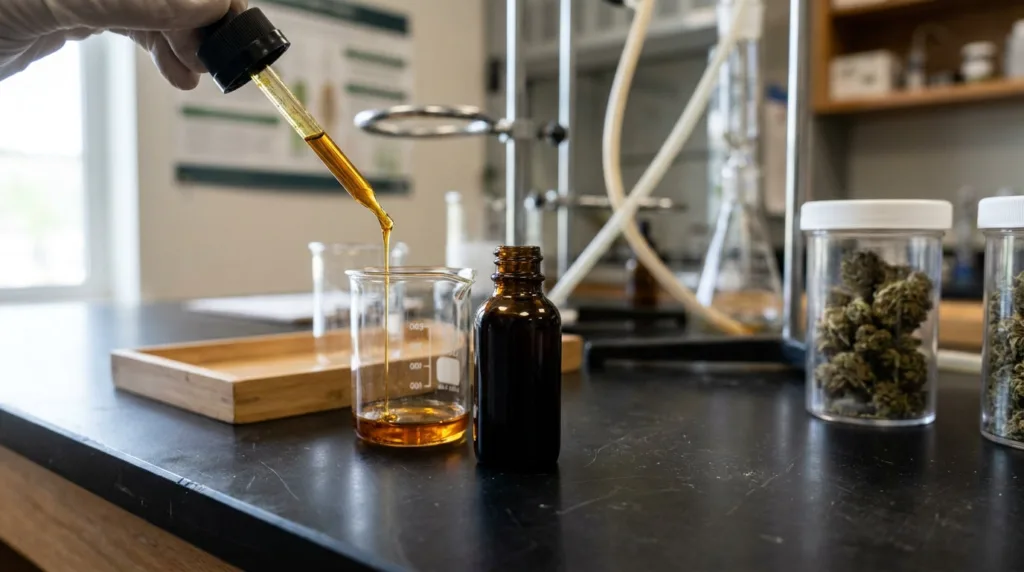
Full spectrum CBD oil is a whole plant hemp extract containing cannabinoids, terpenes, and flavonoids with trace THC (≤0.3%). It works via the entourage effect, where compounds synergistically enhance each other's benefits.
Table of Contents
- What Is Full Spectrum CBD Oil?
- Full Spectrum vs. Broad Spectrum vs. CBD Isolate: Key Differences
- Will Full Spectrum CBD Oil Show Up on a Drug Test?
- What the Research Says About Full Spectrum CBD Oil
- How to Choose the Right Full Spectrum CBD Oil
- Why Elevate Right Full Spectrum CBD Oil Stands Apart
- Frequently Asked Questions About Full Spectrum CBD Oil
What Is Full Spectrum CBD Oil?
Full spectrum CBD oil is a whole plant extract derived from hemp that retains the naturally occurring range of cannabinoids, terpenes, and flavonoids found in the original plant material — including trace amounts of THC at or below the 0.3% threshold established by the 2018 Farm Bill. Unlike products made from isolated compounds, a genuine full spectrum hemp extract preserves the plant's complete chemical profile, which is what distinguishes it from broad spectrum and isolate formulations at a molecular level.
To understand why this matters, consider what's actually inside the hemp plant. Researchers have identified well over 100 distinct cannabinoids — CBD and THC being the most widely recognized — alongside dozens of terpenes (the aromatic compounds responsible for hemp's distinctive scent) and a range of flavonoids that contribute antioxidant properties. In a true full spectrum product, these compounds are extracted together rather than separated, maintaining the natural ratios present in the source plant.
This preservation of the complete chemical profile is central to a concept known as the entourage effect — the theory that cannabinoids, terpenes, and flavonoids work synergistically, producing a combined influence that differs from what any single compound achieves alone. Definitive clinical proof is still developing, but the concept is well-referenced in cannabinoid science, and many users report a more noticeable response from full spectrum formulations compared to isolated CBD. Individual results vary based on dosage, bioavailability, and personal biochemistry.
A critical distinction for consumers: legally compliant full spectrum CBD oil contains no more than 0.3% THC by dry weight, as defined under the Farm Bill. This trace amount is far below intoxicating levels but is nonetheless present — a fact that matters for anyone subject to drug testing, which we'll address later in this article.
Not every product labeled "full spectrum" actually delivers a complete cannabinoid and terpene profile. Extraction methods, hemp sourcing, and post-processing decisions all influence whether the final oil genuinely qualifies as a whole plant extract. The sections ahead break down exactly what to look for — from third-party certificates of analysis to sourcing standards — so you can evaluate any product with confidence rather than relying on front-label marketing.
Full Spectrum vs. Broad Spectrum vs. CBD Isolate: Key Differences
Understanding the difference between extract types is the single most important step before choosing a CBD product — yet it's where most buyers get lost.
The core distinction comes down to what remains in the extract after processing. Full spectrum CBD retains the complete range of cannabinoids, terpenes, flavonoids, and other naturally occurring hemp compounds — including trace amounts of THC (up to the federally legal 0.3%). Broad spectrum undergoes additional refinement to remove THC while attempting to preserve the remaining cannabinoid and terpene profile. CBD isolate strips everything away except pure cannabidiol, delivering a single-compound product with no other plant molecules.
Here's a side-by-side comparison:
[PRODUCT:1]| Feature | Full Spectrum CBD | Broad Spectrum CBD | CBD Isolate |
|---|---|---|---|
| CBD present | Yes | Yes | Yes (99%+ pure) |
| THC content | Up to 0.3% | Non-detectable / removed | None |
| Other cannabinoids (CBG, CBN, CBC) | Yes — full profile | Partially retained | None |
| Terpenes & flavonoids | Yes — naturally occurring | Some may remain | None |
| Entourage effect potential | Highest | Moderate | Minimal |
| Best suited for | Users wanting whole-plant benefits | THC-sensitive users wanting some synergy | Users needing zero THC or precise CBD-only dosing |
Why the Entourage Effect Matters
The entourage effect is the theory that cannabinoids and terpenes work synergistically — meaning the combined compounds may support the body's endocannabinoid system more effectively than any single molecule alone. This is the primary reason many users gravitate toward full spectrum formulations. Current clinical evidence hasn't definitively proven full spectrum outperforms isolates for every individual — efficacy depends on dosage, bioavailability, and personal endocannabinoid system variation — but full spectrum extracts deliver a richer chemical profile, and many users report a more noticeable, well-rounded experience.
So Which Type Should You Choose?
If you have no sensitivity to THC and want the most complete hemp-derived experience, full spectrum CBD is the strongest starting point. Broad spectrum suits those concerned about workplace drug testing, while CBD isolate serves users who need precise, flavorless dosing with absolutely no other compounds. Whichever type you choose, always verify claims through third-party certificates of analysis — the label is only as trustworthy as the lab results behind it.
Will Full Spectrum CBD Oil Show Up on a Drug Test?
This is one of the most important questions buyers ask, and you deserve a straight answer: yes, it's possible. Full spectrum CBD oil contains trace amounts of THC — legally capped at no more than 0.3% by dry weight under federal hemp regulations. While that's a very small amount, it doesn't mean your body ignores it entirely.
Most standard workplace drug tests screen for THC metabolites, not CBD. The issue isn't whether a single serving contains enough THC to trigger a positive result — in most cases, it won't. The real concern is accumulation over time. If you're using a high-potency product at substantial daily servings, those trace amounts can build up in fatty tissues. For heavy, consistent users, THC metabolite levels may cross the typical 50 ng/mL immunoassay threshold, even though you've never consumed a marijuana product.
Several factors influence this risk:
- Serving size and frequency — larger, more frequent doses increase total THC exposure
- Individual metabolism — body fat percentage, hydration, and metabolic rate affect how long THC metabolites remain detectable
- Product accuracy — some products contain more THC than labeled, which is why verified third-party Certificates of Analysis matter
the FDA does not currently regulate CBD products the same way it oversees pharmaceuticals, meaning potency and labeling accuracy can vary significantly between brands. Independent lab testing remains your most reliable safeguard.
We cannot guarantee that any full spectrum product will allow you to pass a drug test. Anyone subject to regular screening — whether for employment, athletics, or legal compliance — should discuss CBD use with their healthcare provider and consider whether a THC-free formulation might be more appropriate. Transparency isn't a marketing tactic — it's the baseline for trust.
What the Research Says About Full Spectrum CBD Oil
As interest in hemp extract continues to grow, so does the body of peer-reviewed research exploring how cannabinoids interact with the human body. However, it is important to distinguish between promising preliminary findings and established medical conclusions. Below, we focus specifically on what recent studies have — and have not — demonstrated.
The CANOA Osteoarthritis Trial
One of the more rigorous investigations into CBD products in recent years is the CANOA trial, a randomized controlled study examining cannabidiol in the context of knee osteoarthritis. Published in 2025, the trial enrolled participants who received either a CBD formulation or placebo over several weeks. Researchers observed modest changes in patient-reported outcomes, though the study's authors were careful to note that the results do not constitute evidence that full spectrum CBD oil can manage joint conditions. General health information sources such as Medical News Today and Verywell Health have similarly noted that large-scale replication studies are still needed before firm conclusions can be drawn .
Myofascial TMD: A Single Case Report
A 2025 case report documented the experience of a patient with myofascial temporomandibular disorder (TMD) who used a CBD-containing regimen as part of a broader care plan. The authors noted improvements in self-reported comfort levels but emphasized that a single case report cannot establish causation. Preliminary research suggests cannabinoids may interact with pain-signaling pathways, yet further controlled trials are necessary before any clinical recommendations could responsibly be made .
The Role of Expectation: CBD and Placebo Effects
Perhaps one of the most thought-provoking recent studies examined how participants' expectations shaped their experience with CBD. Published in 2025, the research found that individuals who believed they were receiving CBD reported noticeable subjective benefits — even when given a placebo. This finding is significant for anyone evaluating hemp extract products because it underscores that perceived benefits may be partially driven by expectation rather than pharmacology alone . It does not invalidate the potential of full spectrum CBD oil, but it does highlight why double-blind, placebo-controlled methodology matters in cannabinoid research.
The bottom line: science is actively investigating the potential of full spectrum CBD oil, and the findings so far are intriguing rather than conclusive. Staying informed through reputable sources — and maintaining realistic expectations — remains the most responsible approach for any consumer navigating this rapidly evolving space.
How to Choose the Right Full Spectrum CBD Oil
With thousands of CBD products on the market and no universal FDA-approved standard for hemp-derived supplements, choosing the right full spectrum CBD oil demands more than reading a front label. Use the checklist below to separate genuinely premium options from products that fall short.
How Do You Choose the Right Full Spectrum CBD Oil Potency?
Potency is more nuanced than "higher is better." Full spectrum oils are measured in milligrams of total CBD per bottle, and the right amount depends on body weight, individual endocannabinoid system variation, and your reason for exploring CBD. A common starting framework is 1–6 mg of CBD per 10 pounds of body weight, beginning low and titrating upward over several days. Jumping to the highest available potency can lead to diminishing returns — patience during the adjustment period matters far more than raw strength.
Your Quality Checklist
Use the following criteria every time you evaluate a full spectrum product:
- Source of hemp matters. Look for organic hemp grown in the United States. A USDA Organic certification confirms the hemp was cultivated without synthetic pesticides, herbicides, or chemical fertilizers — contaminants that can concentrate in the final extract.
- Extraction method should be clean. Supercritical CO₂ extraction is the gold standard because it preserves the full cannabinoid and terpene profile without leaving toxic solvent residues. Avoid products that don't disclose their extraction process.
- Demand a current COA. A Certificate of Analysis (COA) from an independent laboratory is non-negotiable. It should confirm cannabinoid potency, verify THC at or below 0.3%, and screen for heavy metals, pesticides, residual solvents, and microbial contamination. If a brand can't produce a batch-specific COA, consider that a disqualifying red flag.
- Verify third party tested status. Only products tested by an ISO 17025-accredited laboratory offer reliable, unbiased confirmation that the label matches the contents.
- Read the full ingredient panel. A quality CBD tincture typically contains a carrier oil (MCT or organic hemp seed oil), the full spectrum extract, and minimal additions. Artificial colors, flavors, or unnecessary fillers signal a lower-quality formulation.
- Check label accuracy against the COA. Compare the milligrams of CBD on the product label to the COA's cannabinoid breakdown. Discrepancies greater than 10% suggest poor manufacturing controls, and gaps above 20% may indicate the product was never properly tested against its own labeling — walk away.
- Assess brand transparency. Reputable companies publish farming practices, extraction methods, and lab results openly. The FDA has issued warning letters to brands making unsubstantiated health claims or mislabeling products — transparency is both a quality signal and a compliance indicator.
Why These Criteria Matter Together
No single checkbox guarantees quality on its own. A product can be USDA Organic yet lack a credible COA, or be third party tested but sourced from questionable hemp. The strongest CBD products satisfy every criterion simultaneously — organic sourcing, clean CO₂ extraction, batch-specific COA transparency, verified potency, and honest labeling. When a brand meets all of these benchmarks without hedging, you can shop with genuine confidence. Explore our curated full spectrum cbd oil collection to see these standards in practice.
Why Elevate Right Full Spectrum CBD Oil Stands Apart
If you've absorbed the quality benchmarks above, you already have a rigorous checklist in hand. The challenge is finding a brand that checks every box without compromise. That's precisely where Elevate Right enters the conversation — not with flashy marketing, but with verifiable standards that mirror the criteria discerning buyers should demand.
Sourcing that starts at the soil. Every Elevate Right CBD tincture begins with USDA Organic certified organic hemp grown in nutrient-rich American soil. This isn't a loosely applied label — it means the hemp extract in each bottle is cultivated without synthetic pesticides, herbicides, or chemical fertilizers. Because cannabinoids and terpenes concentrate in the plant's trichomes, clean soil and responsible farming directly influence the quality of the final whole plant extract. Elevate Right treats sourcing as the foundation of potency, not an afterthought.
Extraction designed to preserve the full profile. Many brands strip away minor cannabinoids and terpenes during processing, leaving a product that's "full spectrum" in name only. Elevate Right uses a gentle CO₂ extraction method calibrated to retain the complete range of cannabinoids, terpenes, and flavonoids found in organic hemp — the very compounds that work synergistically to deliver what researchers describe as the entourage effect.
Transparency you can actually verify. Each batch of Elevate Right full spectrum CBD oil is third party tested by an independent ISO-accredited laboratory, and the resulting COA (Certificate of Analysis) is published directly on the product page. These reports confirm cannabinoid potency, terpene content, and the absence of heavy metals, residual solvents, and microbial contaminants. You're never asked to take the company's word for it — the data is there for anyone to review.
Potency options built around real needs. Not everyone requires the same serving strength. Elevate Right offers multiple potency tiers across its hemp extract lineup, making it straightforward to start low and adjust gradually — an approach that aligns with best practices for individual dosing rather than a one-size-fits-all mentality.
When a brand's practices align this closely with evidence-based quality markers, choosing becomes less about hope and more about confidence. Explore the full lineup of full spectrum CBD oil options from Elevate Right and see every COA for yourself.
Frequently Asked Questions About Full Spectrum CBD Oil
Does full spectrum CBD oil contain THC?
Yes. By definition, full spectrum CBD oil retains the complete range of cannabinoids naturally present in hemp — including trace amounts of THC. Under the 2018 Farm Bill, legal hemp-derived products must contain no more than 0.3% THC by dry weight. This small concentration is what distinguishes full spectrum CBD from broad spectrum formulations (which remove THC entirely) and CBD isolate (which strips away all compounds except cannabidiol). The presence of THC alongside other cannabinoids, terpenes, and flavonoids is what enables the entourage effect — the theory that these compounds work synergistically.
Join Our Newsletter
Sign up to be the first to know about our can't-miss product drops, special VIP offers & exclusive discounts.